
If you’ve done a Google search lately, you may have seen a Google AI Overview at the top of the results page. It likely gave you a clear, detailed answer to your question, along with a few helpful links.
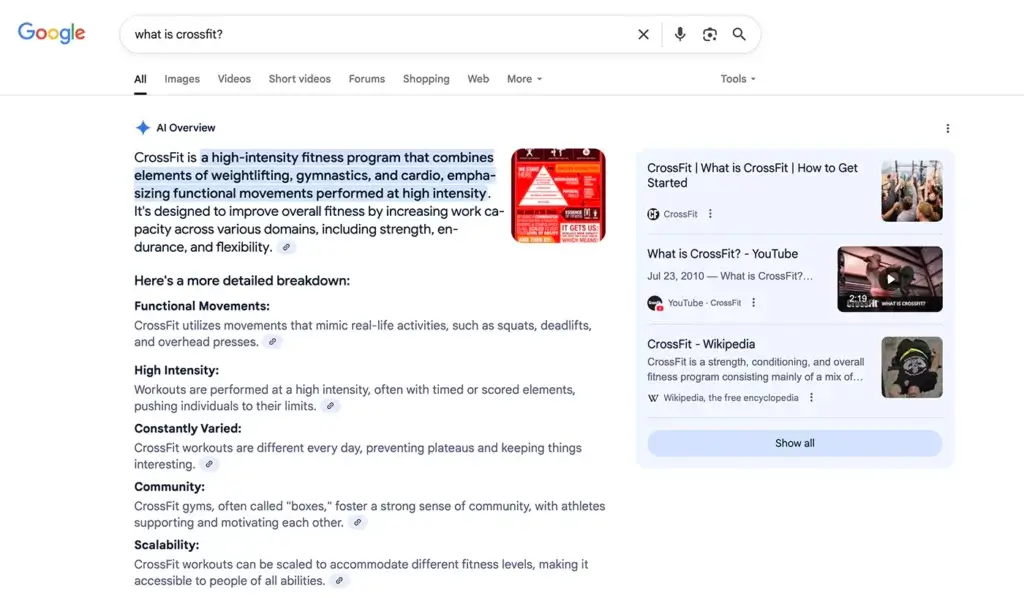
If you found that AI-generated response useful, you’re not alone. The popularity of Google AI Overviews (AIOs) is the reason they now appear in Position 1 of search results 87.6% of the time.
AIOs are quickly becoming the new standard. Their rise is already affecting traditional SEO, especially when it comes to click-through rates and traffic.
For gym owners trying to grow or even just maintain their website’s performance, this shift matters.
The good news? Adapting to this new, AI-driven search landscape isn’t as hard as it sounds.
In this post, we’ll walk you through how to adjust your strategy and make your gym’s website more visible on Google using a newer approach called GEO (Generative Engine Optimization).
Here’s what we’ll cover:
- What is GEO?
- Why does GEO matter to gym owners?
- How is GEO different from SEO?
- What is E-E-A-T?
- What are the 4 Key Principles of GEO?
- Q&A
What is GEO?
Generative Search Engine Optimization (GEO) is the process of optimizing your content so it shows up in AI-generated answers across platforms like:
- Google AI Overviews
- Microsoft Copilot
- ChatGPT
- Virtual assistants like Siri and Alexa
The goal of GEO is to increase the chances that your content appears in AI-generated summaries, answer boxes, or citations when people search for information online.
Why GEO Matters to Gym Owners
Since the launch of AI search overviews, websites in Position 1 of Google’s traditional search results have seen an average 27% drop in click-through rate.
More people are getting their answers directly from AI instead of clicking through blue links. And that shift can seriously impact your website’s performance.
That’s why it’s important to combine GEO with your traditional SEO strategy. By doing both, you give your content a better chance of being cited by AI tools and showing up where people are actually looking.
How Does GEO Differ from Traditional SEO?
A traditional SEO strategy focuses on helping your content rank higher on search engine results pages (SERPs). It’s about working with Google’s algorithm to climb the rankings and get more clicks.
GEO takes a different approach. Instead of just trying to rank in a list of links, GEO is about getting large language models (LLMs), like the ones that power Google AI Overviews and ChatGPT, to choose your content as a trusted answer to someone’s question.
These models look for content that is clear, trustworthy, and well-structured. Since AI-generated answers load directly into the search results or the tool itself, users often get the information they need without clicking a link. This is very different from how traditional SEO works.
Tactically, the strategies are different too:
- SEO relies on keywords, backlinks, and technical page optimization.
- GEO puts more weight on content clarity, authority, and freshness.
What is E-E-A-T?
E-E-A-T stands for Experience, Expertise, Authoritativeness, and Trustworthiness.
Google uses this concept to help its AI search tools prioritize high-quality, credible content. Its Search Quality Evaluators rely on E-E-A-T to assess both the content and the person or business behind it. This is especially important when the topic relates to health, money, or safety.
For gym owners, that means your website should clearly show your qualifications, experience, and reputation.
Let’s break down what each part of E-E-A-T means.
Experience
This is about showing that you have firsthand experience with the topic you’re writing about.
For example, if you publish a blog post about weight loss for people with obesity, you should include real stories from clients you’ve helped. Talk about the unique challenges they faced and how you supported them through it.
This helps prove that you’ve actually worked with the people you’re writing about, not just repeating what you’ve read online.
Expertise
This refers to your knowledge and qualifications on the topic you’re writing about.
Google prefers fitness content that comes from certified professionals or people who clearly know what they’re talking about. For example, you’ll build more credibility if you are:
- A published fitness author
- Certified through NASM, ACE, ISSA, or another well-known board
- A certified group fitness instructor or health coach
- A member of gym owner associations like NGA or IHRSA
Authoritativeness
This is about your reputation in the fitness industry.
Google looks for signs that you or your website are recognized as a trusted source. Some examples include:
- Having a strong presence on social media or fitness forums
- Getting mentioned, recommended, or cited by other reputable websites
- Receiving positive reviews and feedback from visitors and members
Trustworthiness
This is about showing that your content and website can be trusted.
That means being accurate and transparent. Things that help build trust include having clear sources, contact information, and privacy policies. It also helps if your site is secure (uses HTTPS), has minimal ads, and is upfront about what you offer. Avoid anything that feels misleading or confusing, like bait-and-switch tactics.
What Are the Key Components of GEO, and How Do You Address Them?
Terms like “gym” and “gym near me” are searched constantly, especially in January. That’s when people are setting New Year’s resolutions and looking to join a gym or get back into a fitness routine.
Other high-volume keywords include:
- “Boxing gym” – 17,000 monthly searches
- “Best gym” – 2,500 monthly searches
- “Local gym” – 1,400 monthly searches
Curious where this data comes from? We got it directly from an AI Overview by asking, “How does the keyword ‘gym’ rank among searchable topics?”

Since AI Overviews provide summaries along with links to supporting websites, most people don’t scroll much further down the page. And it shows. Websites ranked lower on the search page see an average 10 percentage point drop in click-through rate per position.
This is why your goal isn’t just to rank first, but to be the best answer.
To do that, your content needs to check the four boxes of a strong GEO strategy. Here’s what to focus on.
#1 Relevance to Queries
Traditional SEO focuses on creating content that ranks well in search results. GEO takes it a step further by helping large language models (LLMs) turn your content into direct answers for the questions people are already asking.
Google uses data like user behavior, dwell time, and scroll depth to figure out which questions matter most. It assigns a score to each query based on how useful it is to users. That’s why it’s so important to create content that matches real search intent in the fitness space.
Here are some of the most Googled fitness questions:
- How often should I go to the gym?
- What should I eat before a workout?
- What is pre-workout?
- How many times a week should I work out?
- How do I get a six-pack?
Answering these types of questions clearly and helpfully increases your chances of being pulled into AI-generated summaries.
#2 Search Intent
For Google’s AI tools to understand your content and choose it as an answer, they need to recognize its purpose first. This is called search intent.
Your content should clearly fall into one of these categories:
- Informational: How-tos, guides, tutorials, videos, infographics, or case studies
- Navigational: Pages that help users find information on your site, like a homepage, internal links, or a contact page
- Transactional: Content that supports actions like booking a class, signing up, or confirming a purchase
- Local: Pages focused on a specific area, such as location pages, local case studies, or content that boosts awareness in your community
Once you’ve identified the intent behind your content, think about ways to make it easy to read and engaging. Things like bullet points, CTAs, graphics, charts, Google Maps embeds, and NAP (Name, Address, Phone) citations can help your content stand out and be more useful to readers.
#3 Embedded Trust Signals
As mentioned earlier, GEO works best when your content includes clear trust signals that show E-E-A-T. These signals help AI tools recognize your content as reliable and display it more often.
Here are some ways to build trust into your content:
- Author information: Include a byline with your name and credentials, and add a short author bio at the end of your post. For example: “Dave Case is a native Floridian who has owned the award-winning Gator Gym for over 10 years.”
- Cite reputable sources: AI tools often favor content that references trusted sites like the Mayo Clinic or WebMD. Citing these kinds of sources can boost the credibility of your post. Just make sure to use them where it makes sense, without going overboard.
- First-hand experience: Sharing real examples from your gym, such as case studies or client stories, helps show that you know your stuff. This type of insight is more valuable to AI than general advice pulled from the internet.
- Structured data: Use schema markup on your site to organize content like FAQs, reviews, step-by-step guides, or speakable text. This helps search engines and AI tools better understand your pages.
- Up-to-date content: AI prefers fresh information, so include a timestamp like “Updated August 2025” and keep your examples and references current.
#4 Semantics and Structured Data
To show up in AI-generated responses, your content needs to be easy for large language models (LLMs) to read and understand. That means using the right internal links, clear descriptions, consistent naming, and schema markup that matches how AI systems organize information.
Schema markup (also known as structured data) is a small bit of code you add to your website that helps search engines understand what your content is about. Think of it like a translator for your site. It doesn’t change what people see, but it helps AI tools interpret your content more accurately.
Let’s say your website says: “Mark Mason owns a gym in Knoxville.”
On its own, an AI system might not know who Mark Mason is, what “owns” means in this context, or whether the gym is a business.
With schema markup, you can tell AI exactly what you mean:

This simple code tells the AI:
- It’s a commercial gym
- It’s located in Knoxville, Tennessee
- It was founded by a person named Mark Mason
Adding schema like this can help your gym content show up more clearly and accurately in search results and AI-generated summaries.
Q&A
Let’s wrap up with a few quick answers to common questions gym owners have about GEO.
Q. How can I tell whether my gym’s website is optimized for AI Overviews?
A: Google doesn’t publish a clear checklist for AI Overview optimization, but there are a few tools that can help you evaluate how well your content aligns with what AI systems are looking for.
While these tools don’t guarantee your website will show up in an AI Overview, they can help you follow best practices for GEO, E-E-A-T, and structured data.
Here are a few worth checking out:
- Originality.AI – AI Overview Optimizer: Analyzes your content’s semantic coverage, compares it to pages already featured in AI Overviews, and offers suggestions for improvements.
- AlsoAsked: Helps you discover subtopics and question phrasing that align with what users are searching for.
- Frase.io: Shows how well your content covers a topic and the related questions people are asking.
- MarketMuse: Evaluates topic authority and highlights content gaps that may be keeping you out of AI Overviews.
Q. What kind of content should I prioritize for GEO?
A: Start with the content your members and leads are most likely to search for. That includes:
- Answering common fitness questions
- Highlighting your services and gym location(s)
- Sharing real client success stories
- Creating how-to guides or blog posts with educational value
Focus on content that shows your expertise, experience, and connection to your local community.
Q: Where can I get schema markup tools?
A: There are several free and paid schema markup tools available online. Here are some of the best free options:
- Google’s Structured Data Markup Helper: Great for beginners. You can highlight parts of a page to generate markup.
- Schema.dev Visual Editor: A drag-and-drop builder with rich snippet previews in real time.
- Merkle Schema Markup Generator: Quickly creates JSON-LD code for different schema types.
- Google Rich Results Test: Tests if your markup is eligible for rich results in search and AI tools.
Q: How do I add schema markup code to my website?
A: Adding schema markup to your website is pretty straightforward. Here’s how to do it in three simple steps:
- Use a tool like Google’s Structured Data Markup Helper to create your code in JSON-LD format.
- Open your website’s HTML editor and paste the code into the <head> section of the page you want to optimize.
- Test your page using Google’s Rich Results Test to make sure the markup is working properly.
Q. Do I need a developer to add schema markup?
A: Not necessarily. Many schema markup tools are beginner-friendly and let you copy and paste code without needing to write it yourself. If your website is built on a platform like WordPress, there are also plugins that make the process easier.
That said, if you’re not comfortable editing your site’s HTML, it’s never a bad idea to ask a developer for help.
Kilo gym websites are already structured to align with best practices for GEO, E-E-A-T, and schema markup. So if you’re a gym owner using Kilo, you’re starting with a strong foundation for AI visibility right out of the box.
Q. How often should I update my content or markup?
A: It’s a good idea to review your content and structured data regularly, especially if something on your site changes. That includes things like pricing, class schedules, or locations. You should also update timestamps and examples to keep everything current. AI tools prioritize fresh, accurate information, so these small updates can make a big difference.
Parting Notes
AI-generated search is changing the way people find information and make decisions, including where to work out.
If you want your gym to stay visible and competitive, it’s important to adjust your online strategy to match how Google’s AI tools now deliver results. That means aligning your website with GEO best practices and focusing on clear, trustworthy content.
Kilo gym websites are built with this in mind. Book a call today to see how our GEO-optimized sites can help your gym show up, stand out, and grow.